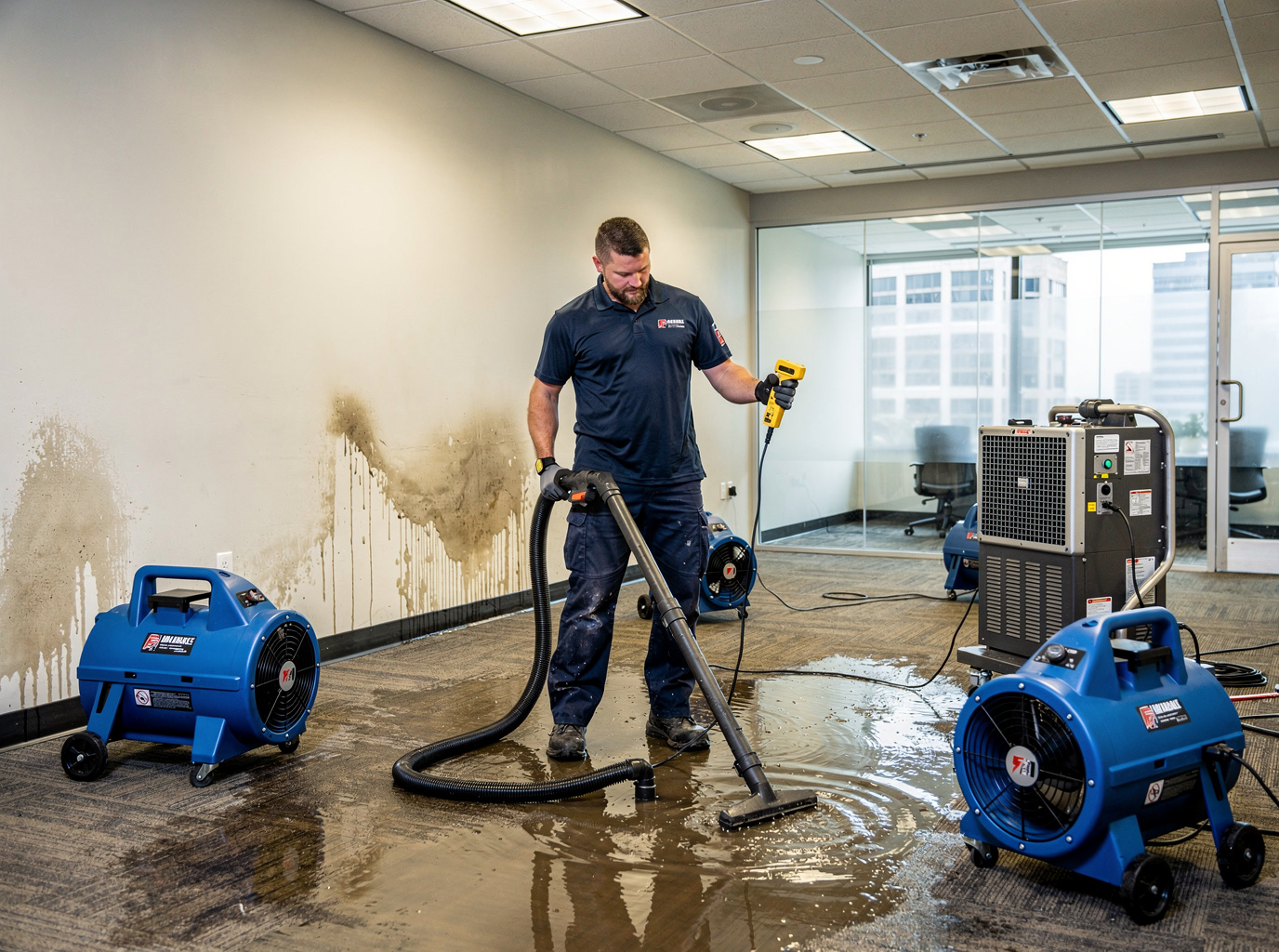
Dallas commercial buildings often sit on clay-heavy soil that shifts with the humid subtropical rains, sending water under slab foundations in East Dallas and Lake Highlands warehouses. Older stock from the 1970s and 1980s around Deep Ellum and Bishop Arts District frequently has flat roofs and aging HVAC that trap moisture behind drop ceilings and in wall cavities. Technicians must pull baseboards early and run commercial dehumidifiers for days rather than hours to prevent hidden mold growth that later triggers TDLR complaints.
Retail spaces in Uptown Dallas and Klyde Warren Park corridors see frequent roof drain failures during sudden downpours. Once water reaches laminated flooring or carpet tile glued to concrete, the adhesive fails and off-gassing begins within 48 hours. Restoration crews isolate HVAC zones immediately, use negative air machines, and document moisture readings at multiple depths so property managers can satisfy insurance adjusters and city inspectors on the same visit.
Industrial and medical tenants near North Dallas and along Central Expressway require separate containment for each suite to meet Dallas Fire Rescue and health department rules. Technicians map electrical panels and data rooms first, then stage desiccant dryers that pull humidity below 40 percent without tripping breakers. Final clearance includes third-party air sampling because commercial leases often mandate it before re-occupancy.
Technician insight
In Dallas the humid subtropical summers keep relative humidity above 60 percent for weeks, so a slow leak behind a commercial drop ceiling in Oak Lawn will wick into drywall long after the initial extraction if crews skip the daily moisture logs.
Uptown retail leak after roof drain clog
Water migrated under laminate in two adjacent storefronts near Klyde Warren Park. Crews isolated the HVAC, extracted under the flooring, and ran desiccant units for four days until slab readings stabilized. Tenants reopened on schedule with documented clearance readings.
Commercial Water Damage Restoration Services We Offer
✓Office Suite Water Extraction
Rapid removal of standing water from carpet, subfloors, and under raised flooring in multi-tenant buildings before it migrates to adjacent suites.
✓Retail Space Drying
Targeted drying of display areas, stockrooms, and point-of-sale zones using low-profile equipment that keeps stores open during after-hours work.
✓Restaurant Kitchen Flood Recovery
Extraction and sanitization of tile, grease traps, and walk-in coolers while coordinating with Dallas health inspectors for quick reopening.
✓Warehouse Structural Drying
Large-scale dehumidification and air movement for high-bay spaces and loading docks where moisture travels through metal decking.
✓Medical Office Contamination Control
Negative-pressure containment and HEPA filtration to protect patient areas during water events in clinics and dental suites.
Commercial Water Damage Restoration Cost in Dallas, TX
| Service | Typical Range | What Affects It |
|---|---|---|
| Small office extraction and drying | $1,200–$3,800 | Varies with carpet vs. hard surface and number of suites involved |
| Restaurant kitchen recovery | $2,500–$6,500 | Includes sanitization and health department coordination |
| Warehouse bay drying | $3,000–$9,000 | Depends on ceiling height and metal deck moisture retention |
| Medical suite containment and drying | $4,000–$11,000 | Higher due to negative air and clearance sampling |
Ranges are typical for Dallas, TX and confirmed with an exact written quote before any work starts.
How it works
- 1
On-Site Assessment
Technician maps all affected zones, tests moisture at slab and wall depths, and notes HVAC paths in the specific Dallas building.
- 2
Water Removal
Truck-mounted and portable extractors pull standing water while protecting electrical panels and data lines common in commercial spaces.
- 3
Drying and Monitoring
Commercial desiccant and refrigerant units run until readings drop below 15 percent, with daily logs shared with property managers.
- 4
Sanitization and Clearance
EPA-registered antimicrobials applied where needed, followed by third-party air sampling required by many Dallas commercial leases.
Pricing
Upfront written estimates after inspection; final cost depends on square footage, water category, and required containment.